- A split sheet records who wrote a song and what share of the composition each person owns. One page, signed by everyone.
- Fill it in the day the song is written, and before release at the latest.
- It covers the song (music and lyrics), not the recording.
- Your collecting society registrations and your release credits should match it exactly.
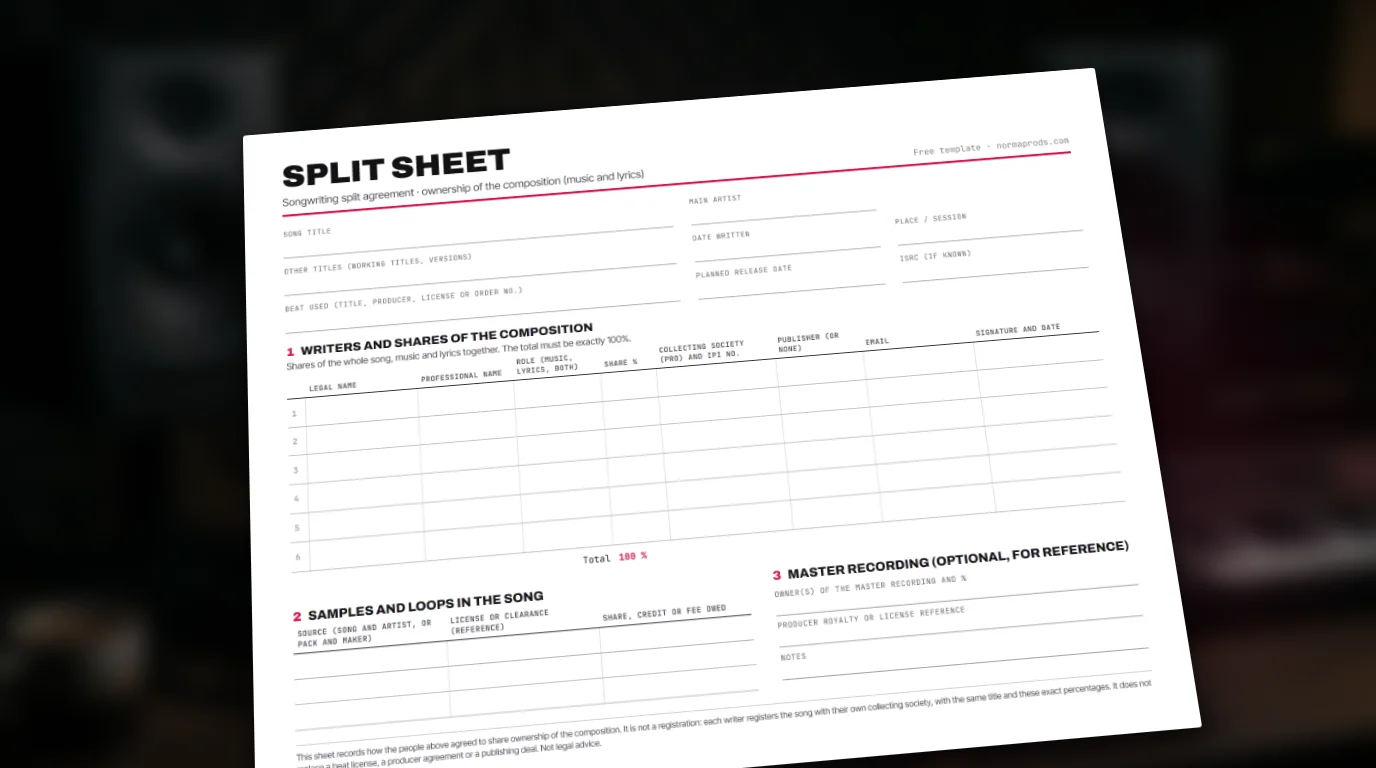
- The free template is below: a PDF to print or fill in, a DOCX to edit.
Most split disputes are not about greed. They are about memory. Three people in a session, a hook written at two in the morning, a beat sent by email months earlier, and then a song that suddenly gets played. By then nobody remembers the same thing, and the money waits until they agree. A split sheet settles it while everyone still remembers.
Producers have the most to lose here. You are often not in the room when the song is written: the artist leased your beat, wrote over it and released it. If nobody writes your share down, the song gets registered without you.
Split sheet, PDF (US Letter, one page) to print or fill in with any PDF reader, or the DOCX version to edit in Word, Google Docs or Pages. French version on A4: PDF.
What a split sheet is, and what it is not
A split sheet is a short written agreement between the people who wrote a song. It lists each writer, their role and their percentage of the composition: the music and the lyrics, the part collecting societies call the musical work. Everyone signs it.
Three things it is not:
- Not a registration. Nothing gets paid because a split sheet exists. Each writer still registers the song with their collecting society, using the numbers on the sheet.
- Not the recording. The master, the actual audio, is a separate copyright, usually owned by the artist or their label. Who owns it, and whether the producer earns a royalty on it, belongs in the license or a producer agreement. The template has a small optional box to note it, nothing more.
- Not a beat license. Your license says what the artist may do with your beat. The split sheet says who owns the song that came out of it. The two should agree.
Collecting societies push for it too. ASCAP does not require one, but its help center says "we encourage you to agree to these percentages in writing".
When to fill it in
The best moment is the session where the song is written, while everyone is still in the room. The latest acceptable moment is before release. Sacem's own guidance says the same thing about declaring a work: do it once the title is final, every participant is identified and the split is settled, and as early as possible before the first play or broadcast (Sacem's online declaration guide, October 2024).
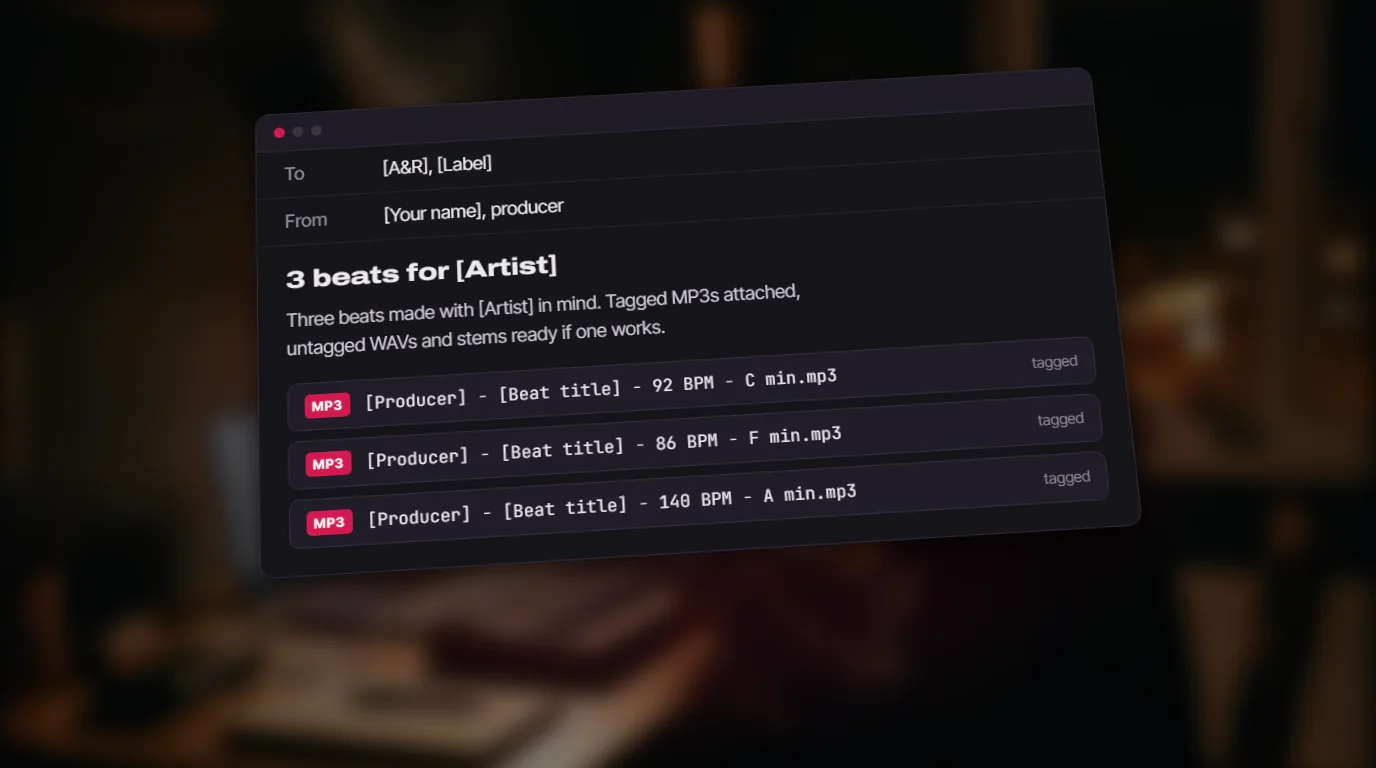
With a leased beat you will rarely be in the session, so make it part of the deal. When an artist tells you a song on your beat is coming out, send the sheet with the beat title and your share already filled in, and ask them to complete the rest. The license already exists; this is one short email.
What goes on a split sheet
The template has three parts: the song, the writers and their shares, then the samples and the master. Here is what each field is for.
| Field | Why it matters |
|---|---|
| Song title and other titles | Registrations are matched by title. Listing working titles and versions avoids two entries for one song. |
| Beat used | Title, producer, and license or order number: it ties the song to your license. |
| Legal name | The name contracts and payments are made under. Some distributors require it for songwriter credits:DistroKid asks for songwriters' real names. |
| Professional name | The name people know, so everyone can tell who is who. |
| Role | Music, lyrics or both. In France, Sacem splits some rights between authors (lyrics) and composers (music), so the role changes the money. |
| Share % | The heart of the sheet. All writers together: exactly 100%. |
| Society and IPI number | The IPI is the identifier attached to each name a writer uses, an 11-digit number in Sacem's words. It lets registrations in different countries point to the same person. |
| Publisher | The publisher or administrator who collects the publishing side for that writer, or "none". |
| Signature and date | On paper or with an e-signature tool. A sheet nobody signed is just notes. |
| Samples and loops | Every sample or third-party loop in the song, its license or clearance, and any share or credit owed to its owner. |
| Master (optional) | Who owns the recording, and a reference to the producer royalty or license if there is one. |
How to agree on the percentages
No collecting society sets them for you. ASCAP's answer to "how do I decide royalty percentages" is that they are completely up to you and your collaborators. Three starting points:
- Equal split. Everyone who wrote gets the same share. Simple, fast, and nobody has to measure who wrote more of the hook.
- Music and lyrics in halves. 50% for the music, 50% for the lyrics, each half divided among the people who wrote that part. It mirrors how Sacem shares performance rights on a work with no publisher: half to the authors, half to the composers.
- By contribution. Percentages that follow who wrote what. Fairer on paper, longer to agree on.
Here is how the first two play out on a simple rap song. The producer made the beat. The artist wrote the verses. A second writer wrote the hook, words and melody.
| Writer | Wrote | Equal split | Music and lyrics in halves |
|---|---|---|---|
| Producer | The beat | 33.34% | 25% (half of the music) |
| Artist | The verses | 33.33% | 25% (half of the lyrics) |
| Co-writer | The hook, words and melody | 33.33% | 50% (half of the music, half of the lyrics) |
| Total | 100% | 100% |
Neither column is the right one. It is an example of how much the method changes the result, which is exactly why the method has to be agreed before the numbers.
Two cases decide part of the answer before you even talk:
- A leased beat. Read your license first. It may already state the share of the composition you keep as the producer. The split sheet must match it; if it says nothing, agree before release, not after.
- Samples and loops. If the beat uses a sample of an existing song, the writers and publishers of that song are owed a share, which you work out with them: ASCAP suggests finding them through its repertory search and contacting the publishers. Loops bought from other producers come with a license too: read it, some ask for a credit or a share when a song is released commercially. Note both on the sheet. More on what you can safely use in where to get samples you can sell.
How collecting societies read your percentages
Your sheet speaks in shares of the whole song. Each society enters them its own way, so the same 40% can look different on screen. That is normal, as long as everyone starts from the same sheet.
| Society | How the shares are entered | Without a publisher |
|---|---|---|
| ASCAP (US) | All writer shares total 50% and all publisher shares total 50%, for 100%. A writer with 40% of the song enters 20% on the writer side. | If you publish your own works, you receive both your writer and your publisher shares (ASCAP). |
| BMI (US) | Writers' shares total 100%; publishers' shares do not exceed 100%. | If no rights were assigned to a publisher, the full publisher share is divided between the writers in the same percentages (BMI registration form). |
| Sacem (France) | You enter the shares as the PHONO key (mechanical reproduction), which must total 100%. Performance and broadcast rights follow fixed keys. | On an unpublished work, performance rights go half to the authors and half to the composers (Sacem). |
Two more pieces of the US picture. Streaming mechanical royalties are collected by The MLC, not by ASCAP or BMI, and a writer without a publisher or administrator can join it as a self-administered songwriter. And if you are registered only as a writer, with no publisher entity or administrator, you can miss the publisher side of performance royalties: DistroKid's help center says it plainly while selling its own publishing service, so compare offers before you sign anything.
Elsewhere, PRS in the UK, SOCAN in Canada and the other societies have their own screens. Check their help pages before you file, and keep the sheet next to you while you do.
After signing: register, credit, keep it
- Send a copy to everyone. A PDF named after the song, in a folder every writer can reach. If the sheet only exists on one phone, it does not exist.
- Register. Each writer registers or confirms the song with their own society, with the same title and the same percentages. At Sacem, the online declaration is signed electronically by every creator and is only validated once all of them have signed; a co-writer who is not a Sacem member receives an email link to sign (Sacem guide).
- Credit. The credits in the distributor's fields should match the sheet: producer, plus songwriter or composer for each writer, under the name each field asks for. The details are in the guide to selling beats online, in the part about credits and royalties.
- Keep the recording money separate. Distributor splits, like DistroKid Splits, divide the earnings the distributor pays for the release. Songwriting royalties come through the societies and publishers. Setting up one does not settle the other.
Mistakes that cost producers money
- Waiting until the song is doing numbers. Agreeing on 10% of nothing is easy. Agreeing on 10% of a hit is not.
- Totals that do not add up. 30 + 30 + 30 is not a split. Fix it on the sheet, not in a registration form.
- Stage names only. Without a legal name and an IPI number, a society cannot match the writer.
- Forgetting the sample or the loop. The owner will not forget it once the song is out.
- Different titles in different registrations. "Night Drive", "Night Drive (Remix)" and "NIGHTDRIVE v3" can end up as three songs.
- Mixing up the master and the composition. A producer royalty on the recording and a writer share of the song are two different things. Write them in two different places.
- No signature. An unsigned sheet is a draft, not an agreement.
One page, ten minutes in the session, and the song can pay everyone who wrote it for as long as it is played. Print the template, keep a few copies in the studio, and send the PDF with every license that turns into a release.
FAQ
Is a split sheet legally binding?
It is a written agreement signed by everyone who wrote the song, which makes it strong evidence of what you agreed. How much weight it carries in a dispute depends on the law where you are and on your other contracts, like the beat license or a publishing deal. For a big release, have a music lawyer read the paperwork.
Do I need a split sheet for a leased beat?
Yes, as soon as a song built on your beat is going to be released. Your license may already say what share of the composition you keep: the split sheet then has to match it, and it adds what the license cannot know, like who else wrote the song and how to identify them.
Does a split sheet register my song?
No. It records the agreement. Each writer still registers the song with their own collecting society (ASCAP, BMI, PRS, Sacem and the others), with the same title and the same percentages.
Can a producer get a songwriter credit?
Yes, when the producer contributed to the composition, which is usually the case for the music of a beat. ASCAP says producers often contribute to the underlying composition and can be registered as writers when they do, and that the decision belongs to the co-writers.
What percentage should the producer get?
There is no official number: ASCAP leaves the percentages entirely to the writers. Two simple starting points are an equal split between everyone who wrote, or half for the music and half for the lyrics, each half divided among the people who wrote it. What matters is that everyone agrees and signs before release.
What if someone refuses to sign?
Do not release until it is settled: unsigned shares are exactly what blocks registrations and payments later. Put the disagreement in writing, propose percentages based on who wrote what, and if nothing moves, bring in a mediator or a lawyer before the song comes out.