- A placement starts with a contact, not with a beat. Most producers spend nearly all their time making beats and a little on contacts. It should be close to the opposite.
- Go straight to the people who choose: A&Rs, managers and the artists themselves, by email or WhatsApp.
- Look for people at the majors on LinkedIn. They probably hear from far fewer beatmakers than artists do.
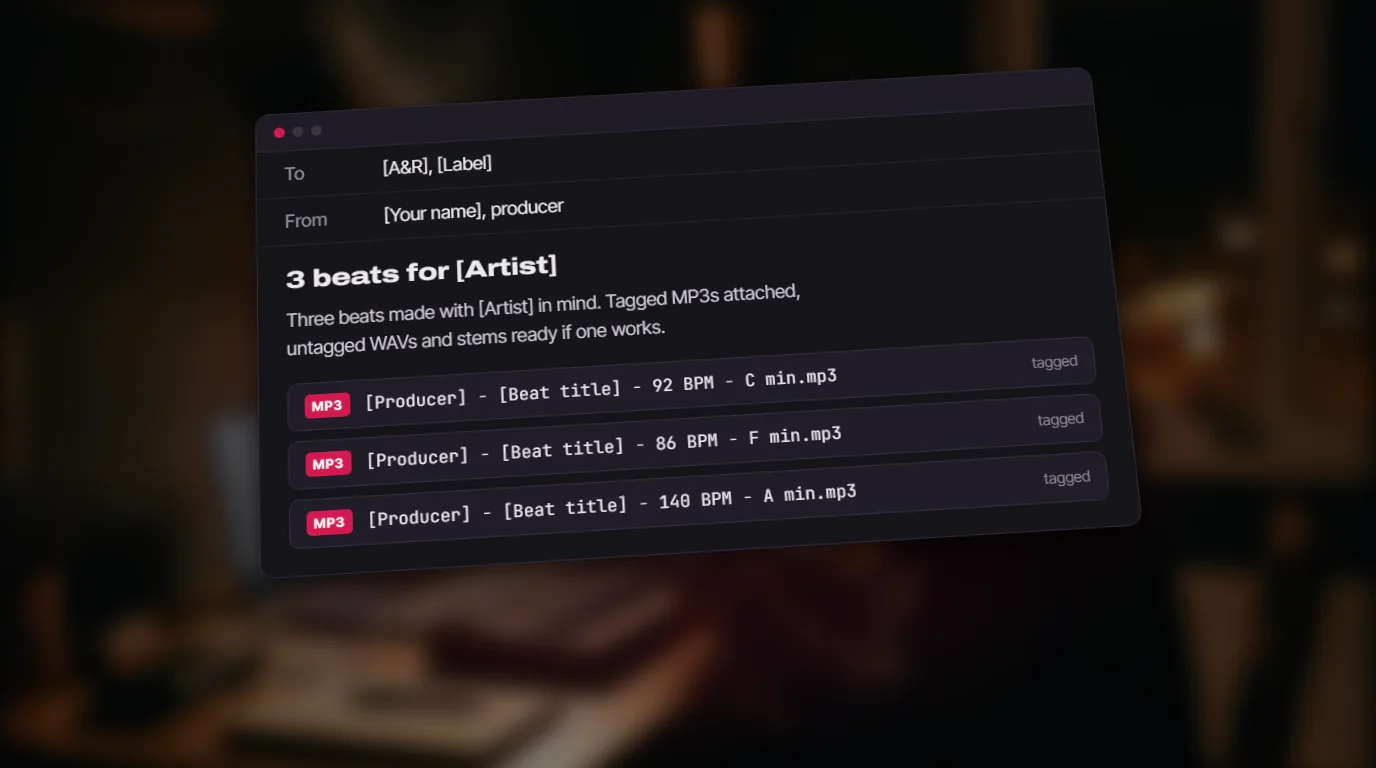
- Send one or two emails with three beats at most: tagged MP3s, each with a clear name.
- Don't count your sends. In our experience, a lot of beats get heard and passed on, and a pass can still teach the artist your sound.
- Settle the split before release. On our placements: half for the artist side, half for the production side.
Most advice about placements is written from the studio chair: make better beats, upload more, wait. On our team at Navigators Crew, getting heard was a job of its own. One person handled it, contacting A&Rs, managers and artists directly. That person was me. The team placed tracks on major-artist releases: 4 certified Gold, 3 Platinum.
This guide is that side of the work. No secret contact list, no paid submission service. Just what we did, and what I would tell any producer who wants their first placement.
What a placement is
A placement is a track built on your beat that an artist releases officially, usually with a team or a label behind it. It is a different path from selling leases. With a lease, an artist finds your beat in your store and buys a license. With a placement, someone chooses your beat for a project: the artist, their manager, an A&R. You get there by being in front of those people when they are choosing. The word has a second meaning, sync: music placed in a film, a series, an ad or a game. That is another market, with its own contacts and contracts, and not what this guide covers.
That is why the beat is only half of the work. The other half is being known by the people who choose. Placements are also one income among several, next to leases, exclusives and the rest: how to make money as a music producer covers the whole picture.
The mistake I see most: making beats and waiting
Most producers who want placements are not proactive. They make beats, maybe send a few somewhere, and go back to making beats. They never build a real network, or a rhythm of sending with regular contact that marks their ground.
The usual balance is mostly beats and a little outreach. It should almost be the other way around. Your beats matter, but an artist can only pick a beat they have heard, from someone they remember.
Who to contact
Don't be afraid to go and find the artists where they actually are. There are a lot of ways in. These are the people we contacted.
| Who | What they do | How we reached them |
|---|---|---|
| A&R | Works for the label: finds artists and songs, and brings in producers for a project (Berklee's description of the role). | |
| Manager | Works for the artist, and decides a lot of what reaches them. | Email, then WhatsApp once we had the number |
| The artist | Has a big say in the final choice, along with their manager and label. | Directly, by email or WhatsApp |
| People at the majors | Label staff who work on the artists' projects. | Found on LinkedIn, then contacted by email |
The last line is the one most beatmakers skip. Everyone writes to the artist. Far fewer look for the people working at the majors on LinkedIn, get a contact and an email address, and write to someone who probably receives far fewer messages from beatmakers. So yours probably stands a better chance of being read.
How to find the contacts
Contacts are not secret, they are scattered. A few places to look:
- LinkedIn. Search a label's name with "A&R", or the name of an artist on its roster. Many label employees list their role there.
- The credits. Spotify shows the credits of a song, writers and producers included when the label or distributor has filled them in, and the label is printed under each release. Reading the credits of the artists you want tells you who works around them.
- The artist's own channels. Business emails in Instagram or YouTube bios, management and booking contacts. A manager's email is often already there.
- The managers themselves. Once a manager has answered, ask if you can send beats on WhatsApp. That is how we got WhatsApp numbers.
Write to professional addresses, about their work, one person at a time, under your real name, and stop if someone asks you to. A pitch is one person writing to another: never add these contacts to your newsletter, a mailing list needs their consent.
What to send: three beats, tagged, well named
What we sent was simple, and always the same shape: one or two emails, with three beats at most. MP3s with the tag in them, and file names that say exactly what each beat is. By email, or by WhatsApp once we had the number.
- Three beats at most. Enough to show a direction without asking for an hour of someone's time.
- MP3 with the tag. Light enough to play straight from a phone, and the tag keeps your name on the beat while it gets passed around. The untagged WAV and the stems come later, when someone wants the beat.
- Names that do the work. A file called "beat 4 final.mp3" gets lost in a download folder. Put your name, the beat title, the tempo and the key, for example
YourName - Beat Title - 92 BPM - C min.mp3. - Beats that hold up. Your beat will be played right after songs that are already out. Check it against a commercial reference before it leaves: mixing and mastering your beats covers the order of operations.
Subject: 3 beats for [Artist], from [your name]
Hi [first name],
I'm [your name], a producer [one line of real proof, if you have one]. Here are three beats I made with [Artist] in mind:
[Your name] - [Beat 1] - 92 BPM - C min.mp3
[Your name] - [Beat 2] - 86 BPM - F min.mp3
[Your name] - [Beat 3] - 140 BPM - A min.mp3
Tagged MP3s attached. Untagged WAVs and stems are ready if one works.
[Your name] · [phone] · [store link]
Keep it that short. The beats do the talking; the email only has to get them played.
Don't count your sends
Don't keep score of how many beats you send. There are very few placements compared to the number of beats sent, and counting will only discourage you. Some emails will never be opened, and in our experience, most of the beats that do get heard are not kept.
That is not wasted. A beat an artist passes on can still teach them your style. Through those refusals, they can learn what you do and start to recognize you, so that when the moment is right for a project, they know where to come. Nothing is guaranteed, but that is what building ground with an artist means: being the name they already know when they need something.
So keep a rhythm: new beats, regular contact, the same people over time. A simple spreadsheet with the contact, the date and the beats you sent is enough. Not to measure yourself, just to never send the same beat twice to the same person.
When an artist wants a beat
The day someone says yes, things move fast. Have this ready before you start sending:
- The files. The untagged WAV and the stems (each sound on its own track), named as clearly as the MP3.
- Your samples and loops. A sample of a record has to be cleared before release. Loops bought from other producers come with a license: read it, some ask for a credit or a share when a song is released commercially. Better to know before the label asks. More in where to get samples you can sell.
- The split. Who wrote what, and what share of the song each person owns, signed before release. Use the free split sheet template.
- The deal on the recording. Any fee, advance or royalty on the master is set in a contract with the artist or the label. Get it in writing, and for a major release, have a music lawyer read it.
- Registration and credits. Register the song with your collecting society (ASCAP, BMI, Sacem and the others) from the shares on the split sheet: each society enters them its own way, and some rights follow fixed keys (details in the split sheet guide). Check your producer and songwriter credits on the release too. In the US, SoundExchange collects royalties on the recording from digital radio such as SiriusXM, Pandora or iHeartRadio, not from on-demand streams. A producer can receive part of the featured artist's share of that money through a letter of direction filed by the artist: ask for it when the deal is made. It does not replace your royalty on the master, which comes from your contract.
How the splits worked on our placements
On the credits side, we kept it very simple. On our placements, the artist side kept 50% of the song and the production side 50%. When outside producers worked on a track, the team's rule never changed: the production half was shared equally between the producers, always.
| Producers on the track | Artist side | Production side |
|---|---|---|
| One | 50% | 50% |
| Two | 50% | 25% + 25% |
| Three | 50% | 16.67% + 16.67% + 16.66% |
Nobody imposes these numbers: ASCAP, for example, leaves the percentages entirely to the writers. Equal shares were our choice, not a rule of copyright: they remove the argument, which keeps people working together. Only list the people who actually wrote part of the song, and whatever you agree on, write it on a split sheet and get it signed before the song comes out.
Where to start this week
- Make a short list of artists whose sound is close to your beats.
- For each one, find the manager, the label and, on LinkedIn, someone at the label who works on their projects.
- Pick three beats per artist: tagged MP3s, named properly, with the WAVs and stems ready behind them.
- Check your store. A manager who likes a beat will look you up, and your BeatStars profile is your business card.
- Send, note the date, and come back with new beats.
Making beats is the part you already love. The outreach is the part that gets them heard. Give it at least as much time.
FAQ
Do I need a manager to get placements?
No. On our team, one person did the outreach to A&Rs, managers and artists. A manager can open doors, but direct outreach works if you keep at it, with regular contact and new beats.
Should I send tagged or untagged beats?
We sent tagged MP3s for the first contact, so the producer's name stays on the beat while it gets passed around. The untagged WAV and the stems go out once someone wants the beat.
How many beats should I send at once?
We sent three at most, in one or two emails: enough to show a direction, short enough to be played to the end.
How do I find an A&R's email?
Start with LinkedIn: search the label's name with A&R, then find a professional address. Song credits on streaming services, label websites and the artist's management contacts help too. Write about their work, one person at a time.
How are splits decided on a placement?
There is no official rule: ASCAP, for example, leaves the percentages entirely to the writers. On our placements, the artist side kept 50% and the production side 50%, shared equally between the producers on the track. Put it on a signed split sheet before release.
How long does it take to get a placement?
There is no fixed timeline, and counting your sends will only discourage you. Very few beats get placed compared to how many are sent. Each send can still build the relationship, so that when the right project comes, the artist knows where to find you.