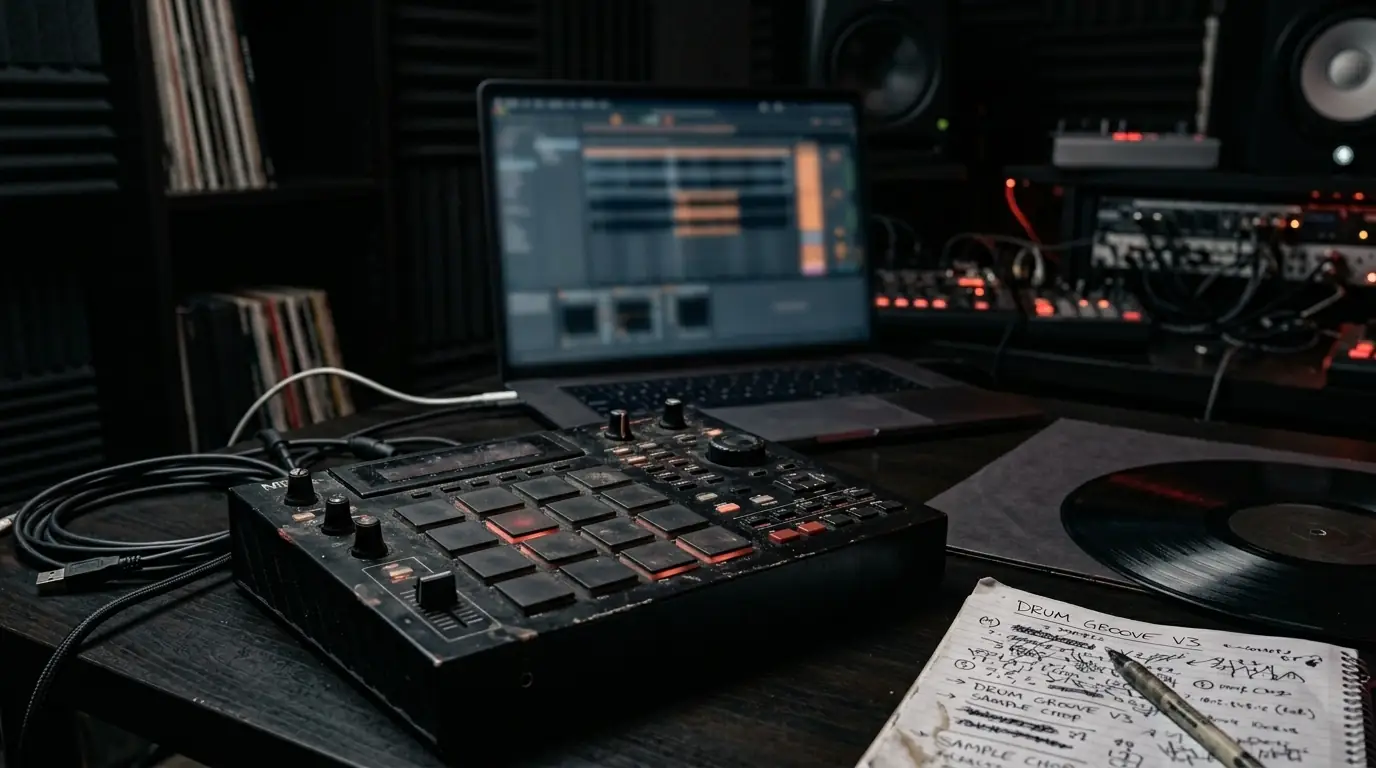
The best Suno prompts for sampling are not trying to generate a full song. They are trying to generate raw material: loops, textures, chords, phrases, and sections that survive after you chop them.
That means the prompt has to act like a crate-digging brief. You are not asking for a polished release. You are asking for a source record: a usable mood, a stable section, enough texture to feel alive, and enough empty space to let your drums take over.
Start with constraints
Use direct constraints: no vocals, no drums, no chorus, no bridge, no modern pop arrangement. Suno needs to know what to avoid before it can generate something useful for a sampler.
The mistake is being polite with the model. "Lo-fi soul beat" still invites drums, hooks, and full-song structure. "Instrumental source recording, no lead vocal, no hook, no chorus, loop-based 8-bar sections" gives the model a much tighter job.
Name the era and recording texture
Era changes the sound. A 1970s soul prompt behaves differently from a clean modern R&B prompt. Add texture: tape warmth, vinyl crackle, room tone, dusty keys, muted horns, or worn strings.
Do not stop at "vintage." Use a decade, a recording environment, and a surface. For example: "1973 private press soul, warm tape saturation, small room, slight vinyl surface noise." Those details push Suno toward a believable source instead of a generic retro preset.
Ask for loopable sections
Sampling works better when the output has stable phrases. Ask for repeated 4-bar and 8-bar sections, sparse arrangement, and clear instrumental motifs.
If you plan to chop in Maschine, MPC, FL Studio, Ableton, or SP-404, consistency matters more than surprise. A beautiful one-time fill is less useful than a simple phrase that repeats cleanly and lets you decide where the variation happens.
Use instrument focus
Do not ask for everything at once. Pick a lead source: Rhodes, upright piano, guitar, strings, flute, muted trumpet, bass, or choir texture. Too many instruments make the sample harder to control.
One lead instrument plus one support layer is usually enough. "Rhodes and muted trumpet" will give you clearer chop points than "Rhodes, strings, horns, guitar, choir, flute, bass." The denser the prompt, the harder it is to leave room for your own production.
A strong prompt structure
Genre, era, mood, instrument focus, texture, tempo range, no vocals, no drums, loopable structure. That is the core. Crate Machine turns those choices into a structured Suno prompt for sampling.
A usable structure looks like this:
Instrumental source recording, no vocals, no drums. 1970s soul-jazz loop, warm tape saturation, dusty vinyl texture. Rhodes electric piano, muted trumpet, upright bass. Melancholic late-night mood, 76 BPM, repeated 8-bar sections, sparse arrangement, no chorus, no bridge.
After generation, do not judge the whole song. Hunt for the strongest 4 or 8 bars, pitch it, filter it, and build around that section like you would with a record.
Common prompt mistakes
Do not ask for "sample pack" language. It often produces clean, modern library music. Do not ask for "hip hop beat" if you want a sample source. That can generate drums and arrangements you will have to fight. And do not stack too many moods. "Dark, happy, nostalgic, aggressive, dreamy" gives the model no clear direction.
FAQ
What makes a Suno prompt good for sampling?
It asks for source material, not a song: instrumental, loopable, no vocals, no modern chorus structure, clear era, recording texture, and a focused instrument palette.
Should I prompt Suno for a hip hop beat?
Not if you want a sample source. "Hip hop beat" can generate drums and a finished arrangement. Ask for source recordings, loops, phrases, and textures instead.
Can Crate Machine write the prompt for me?
Yes. Crate Machine turns genre, mood, era, and instrument choices into structured prompts for sample-based beatmaking.
For the full workflow behind this prompt structure, read how to generate samples with Suno AI.